
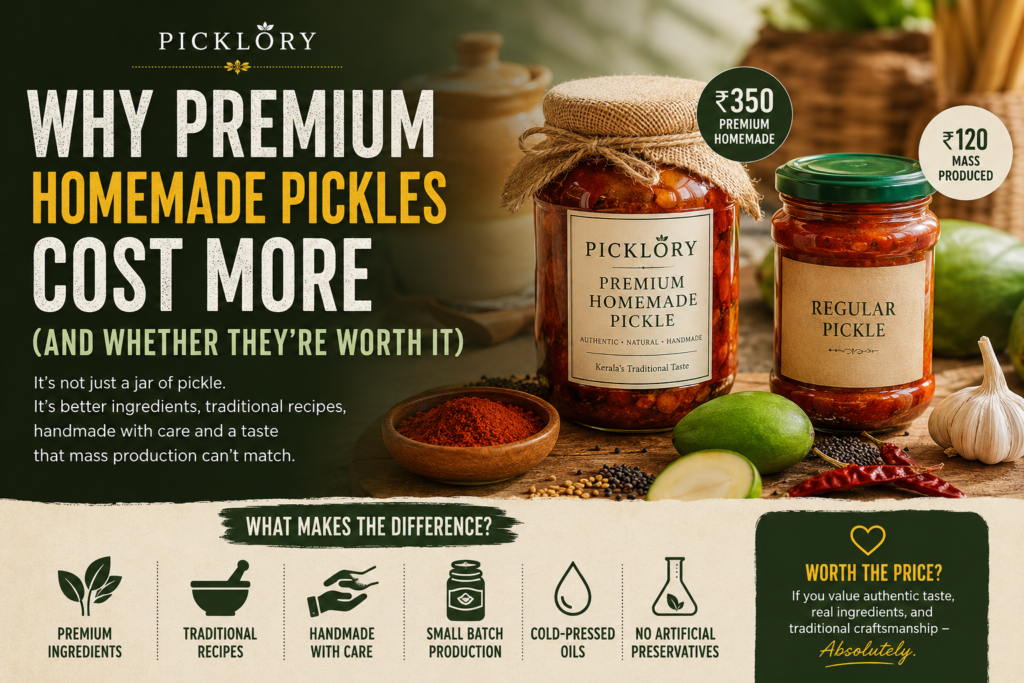
Standing in front of two pickle jars—one priced at ₹120 and another at ₹350—you might wonder:
“They’re both pickles. Why should I pay almost three times more?”
It’s a fair question.
The answer isn’t just about branding or attractive packaging. Premium homemade pickles cost more because they’re made differently—from the ingredients chosen to the time invested in preparing every jar. Unlike factory-made pickles designed for mass production, authentic homemade pickles focus on quality, traditional recipes, and craftsmanship.
If you’ve ever questioned whether premium homemade pickles are worth the extra cost, this guide explains exactly what you’re paying for and helps you decide if they’re the right choice for you.
Quick Answer
Premium homemade pickles cost more because they use better ingredients, traditional recipes, handmade production, small-batch preparation, premium oils and spices, and natural preservation methods instead of mass manufacturing and artificial shortcuts. The higher price reflects quality, authenticity, and craftsmanship—not just the product itself.
Why Homemade Pickles Cost More Than Store-Bought Pickles
The biggest difference lies in how they’re made.
Store-bought pickles are manufactured at a large scale. Companies purchase ingredients in bulk, automate production, use standardized recipes, and often rely on refined oils and preservatives to increase shelf life and reduce costs.
Premium homemade pickles take the opposite approach.
They prioritize:
- Carefully selected seasonal ingredients
- Small-batch preparation
- Handmade processing
- Traditional family recipes
- Premium oils and spices
- Natural preservation
- Manual quality checks
These choices increase production costs but also create a product with richer flavour, better texture, and greater authenticity.
Where Does Your Money Go?
When you buy a premium homemade pickle, you’re paying for much more than the contents of the jar.
| Cost Factor | Why It Costs More |
| Fresh seasonal produce | Higher-quality fruits and vegetables |
| Premium spices | Better aroma and richer flavour |
| Cold-pressed oils | Traditional taste and natural preservation |
| Skilled labour | Washing, cutting, mixing, and packing by hand |
| Small-batch production | Higher cost per jar |
| Quality packaging | Better freshness and product safety |
Unlike factory production, handmade pickles cannot spread costs across hundreds of thousands of jars. Every batch requires time, attention, and skilled work.
Premium Ingredients Increase the Cost
Great pickles begin with great ingredients.
Many commercial manufacturers prioritize consistency and lower costs by purchasing bulk produce. Premium homemade pickle makers select ingredients based on freshness, quality, and seasonality.
Seasonal Fruits and Vegetables
Freshly harvested mangoes, lemons, gooseberries, garlic, and chillies deliver better texture and flavour than produce stored for long periods.
Seasonal sourcing may cost more, but it creates a superior final product.
Premium Spices
Homemade pickles depend heavily on spices.
High-quality mustard seeds, red chilli powder, turmeric, fenugreek, asafoetida, and pepper provide deeper aroma and flavour than lower-grade alternatives.
Cold-Pressed Oils
Traditional homemade pickles often use Kacchi Ghani mustard oil or other cold-pressed oils.
These oils retain their natural flavour and help preserve the pickle while contributing to its authentic taste.
Clean Ingredients
Premium homemade pickles generally avoid unnecessary artificial colours, synthetic flavours, and excessive preservatives. Instead, they rely on ingredients people can easily recognize and understand.
Traditional Handmade Production Takes Time
Making homemade pickles isn’t simply mixing ingredients together.
Every batch involves several manual steps:
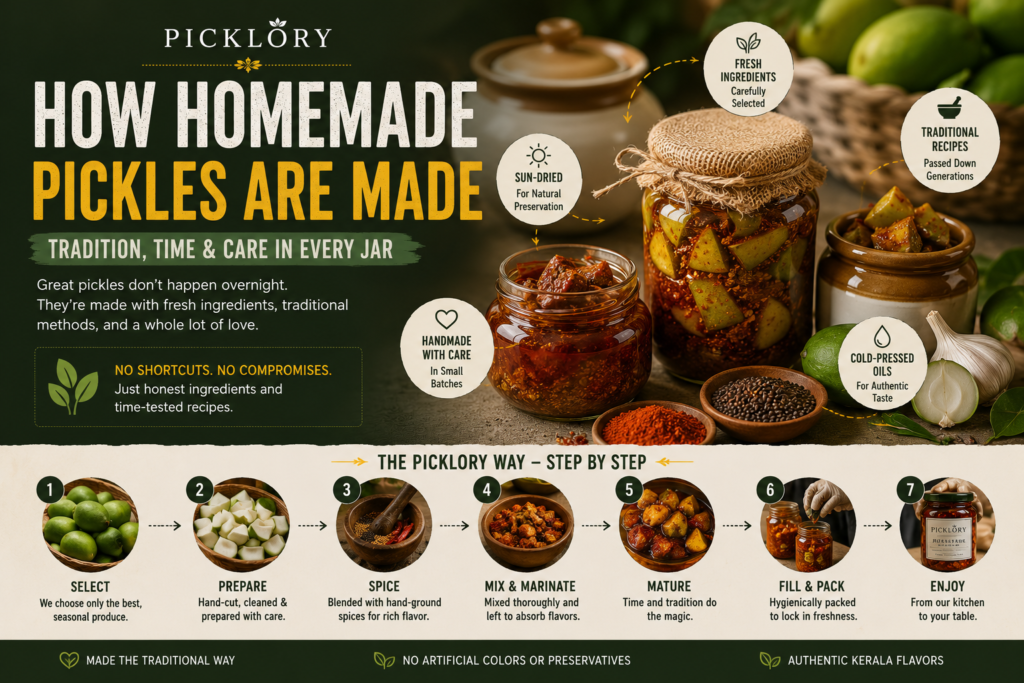
- Washing fresh produce
- Hand-cutting fruits and vegetables
- Sun drying when required
- Mixing spices carefully
- Allowing flavours to mature naturally
- Filling jars manually
- Inspecting quality before packaging
These labour-intensive processes take significantly longer than automated factory production.
Time is one of the biggest reasons premium homemade pickles cost more.
Small-Batch Production Comes at a Price
Large food manufacturers produce thousands of jars every day.
Homemade pickle makers usually prepare much smaller batches.
While this increases costs, it offers several advantages:
- Better consistency
- Closer quality control
- Fresher production
- Reduced storage time
- Greater attention to every jar
Small batches also make it easier to maintain authentic family recipes without compromising quality.
Natural Preservation Instead of Chemical Shortcuts
Traditional pickles have been preserved naturally for generations.
Instead of relying heavily on synthetic preservatives, homemade pickles commonly use:
- Salt
- Oil
- Vinegar
- Natural fermentation
These methods require patience, but they allow flavours to develop naturally while preserving the product.
Natural preservation isn’t necessarily cheaper—it often requires better ingredients and careful preparation.
Authentic Family Recipes Add Real Value
One of the biggest advantages of premium homemade pickles is something factories cannot easily replicate: heritage.
Many traditional recipes have been passed down through generations, preserving regional flavours and cooking techniques.
Kerala-style homemade pickles, for example, are known for their distinctive use of spices, oil, and preparation methods that create bold, authentic flavours.
When you buy premium homemade pickles, you’re often supporting the continuation of culinary traditions rather than purchasing a standardized factory product.
Homemade vs Store-Bought Pickles
| Feature | Premium Homemade | Store-Bought |
| Ingredients | Fresh seasonal produce | Bulk ingredients |
| Production | Handmade | Automated |
| Batch Size | Small batches | Large-scale manufacturing |
| Oils | Cold-pressed oils | Mostly refined oils |
| Preservation | Natural methods | Often uses preservatives |
| Recipes | Traditional family recipes | Standardized recipes |
| Taste | Rich and authentic | Consistent but less distinctive |
| Transparency | High | Varies by brand |
| Price | Higher | Lower |
Are Premium Homemade Pickles Worth It?
The answer depends on what matters most to you.
Premium homemade pickles are worth buying if you value:
- Authentic taste
- Better-quality ingredients
- Traditional recipes
- Handmade craftsmanship
- Small-batch freshness
- Transparent ingredient sourcing
However, if your primary concern is finding the lowest-priced pickle for everyday use, a commercial product may meet your needs.
The real comparison isn’t price versus price.
It’s value versus price.
A premium pickle offers more than food—it delivers craftsmanship, heritage, and quality.
Why Picklory Chooses Quality Over Quantity
At Picklory, every jar reflects the principles behind authentic homemade pickles.
Rather than focusing on mass production, Picklory emphasizes:
- Traditional Kerala recipes
- Small-batch preparation
- Premium seasonal ingredients
- Kacchi Ghani mustard oil
- Carefully selected spices
- Transparent sourcing
- Fresh production
- No unnecessary preservatives
The goal isn’t simply to make pickles—it is to preserve authentic flavours while delivering a product people can trust.
Frequently Asked Questions
Why are homemade pickles more expensive?
Because they use premium ingredients, require manual preparation, and are produced in small batches using traditional methods.
Are premium homemade pickles healthier?
They often contain simpler ingredient lists and fewer unnecessary additives, but health benefits depend on the ingredients, recipe, and portion size. Premium pricing alone does not make a pickle healthier.
Do expensive pickles taste better?
Taste is subjective, but premium homemade pickles generally offer more complex flavours because they use better ingredients, quality spices, and traditional preparation techniques.
Why do small-batch pickles cost more?
Small batches require more labour and cannot benefit from the economies of scale that reduce costs in factory production.
Are premium homemade pickles worth buying?
If you value authentic taste, ingredient quality, traditional recipes, and handmade craftsmanship, premium homemade pickles provide better value despite their higher price.
Final Thoughts
Premium homemade pickles cost more because every stage of production—from sourcing seasonal ingredients to handcrafting each batch—requires greater care, time, and expertise. Unlike mass-produced alternatives, they prioritize quality over volume, authentic flavour over shortcuts, and tradition over standardization.
When you choose a premium homemade pickle, you’re not simply paying for a jar of pickle. You’re investing in fresh ingredients, skilled craftsmanship, regional culinary heritage, and a product made with transparency and attention to detail.
If authentic Kerala flavours, clean ingredients, and traditional recipes matter to you, a premium homemade pickle isn’t just more expensive—it offers value that mass-produced pickles often cannot match.